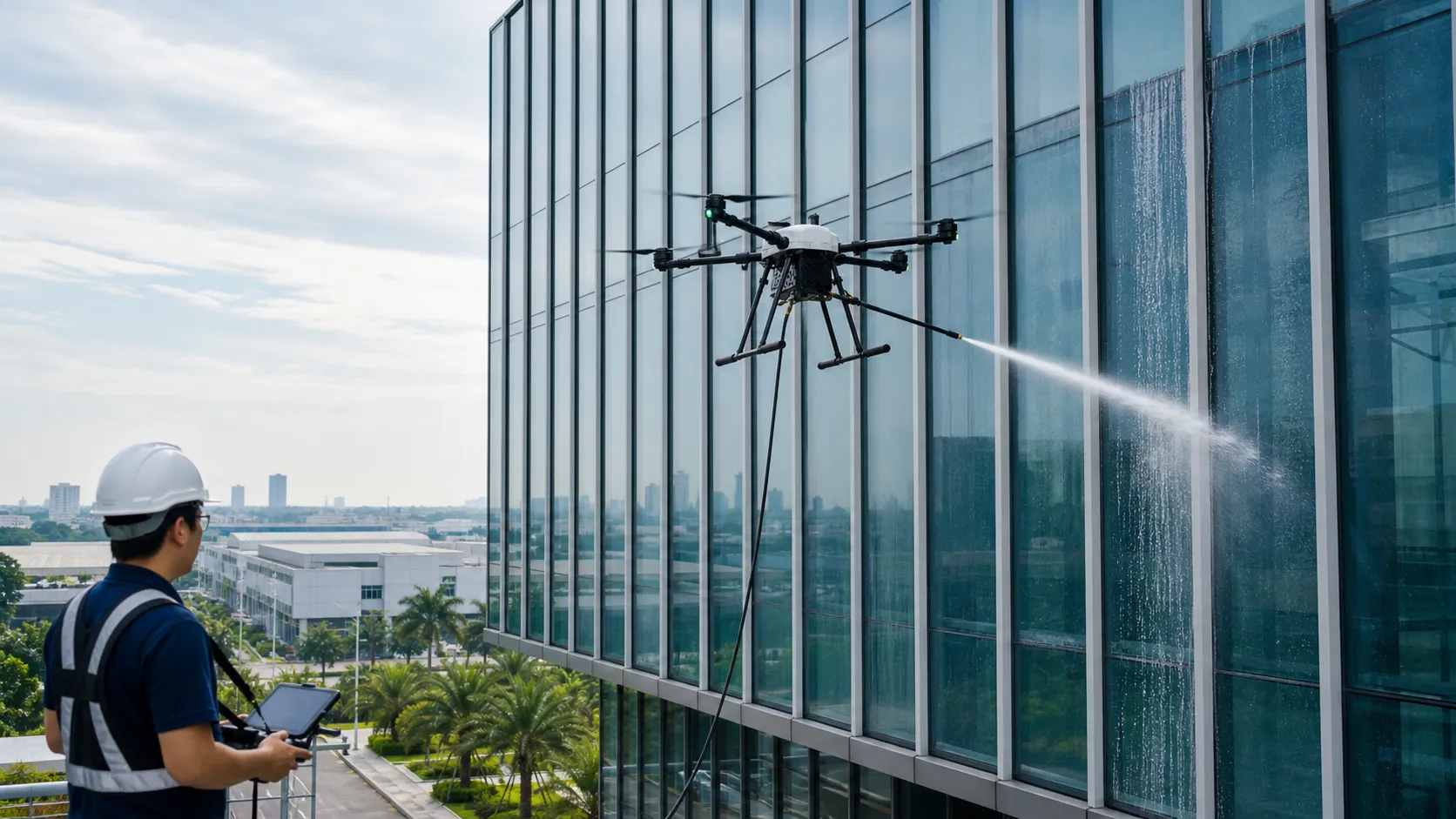
Drone cleaning in Malaysia can be assessed for building facades, glass exteriors, selected rooftops, and solar arrays where access, height, or disruption makes conventional cleaning difficult. It is not automatically the best method for every building. The surface, dirt, site environment, water system, operating area, weather, and approval requirements should be reviewed first.
This guide helps property managers, facility teams, solar asset owners, and industrial operators understand how drone-assisted cleaning works, when it may fit, when another method may be better, and what information to prepare before requesting a proposal from Skybot Solution.
What is drone cleaning?
Drone cleaning uses a specialist unmanned aircraft with a controlled water or cleaning-fluid delivery system to treat selected elevated or difficult exterior surfaces. The operating team remains at a planned ground or access position while directing the aircraft toward the cleaning area.
The equipment is only one part of the job. The method also depends on surface compatibility, water source, hose routing, runoff, wind, surrounding people and property, the ground-control area, and the type of dirt or staining.
Where drone cleaning may be useful in Malaysia
Drone-assisted cleaning is most useful when it solves a real access or disruption problem. Possible applications include:
- Building facades and glass exteriors: Broad elevated sections where scaffolding, lifts, or rope access may disrupt entrances, walkways, parking, or tenants.
- Commercial rooftops: Selected roof areas where unnecessary movement across difficult sections should be reduced.
- Solar arrays: Extensive or elevated layouts that need a surface-compatible cleaning method and controlled operating zone.
- Industrial properties: Sites where cleaning must be coordinated with traffic, equipment, security, and active operations.
The starting point is not the drone model. It is the site problem and the cleaning result required. Review the Skybot service process for the information used during an initial suitability check.
Drone cleaning compared with other access methods
| Method | May suit | Important checks |
|---|---|---|
| Drone-assisted cleaning | Broad elevated sections with suitable flight and ground-control space | Surface and stain compatibility, weather, water delivery, runoff, hazards, and approvals |
| Rope access | Detailed inspection, spot treatment, repair, or cleaning requiring direct hand contact | Anchor system, technician competency, rescue plan, falling-object controls, and access below |
| Mobile elevated work platform | Reachable elevations with firm vehicle positioning | Machine reach, ground loading, overhead obstacles, traffic, and rental period |
| Scaffolding | Long-duration work or projects needing continuous close access | Installation, public access, security, permits, weather, and dismantling |
| Ground-based equipment | Lower and reachable surfaces | Working reach, operator control, water quality, obstacles, and people nearby |
A mixed method may be the best answer. Drone cleaning can cover suitable broad sections while another access method handles repairs, persistent marks, or details that need direct contact.
For a closer method-by-method decision, read the drone facade cleaning versus rope access comparison. It explains where broad-area drone cleaning may fit and where direct technician access is still more suitable.
When drone-assisted cleaning may be suitable
It may be worth assessing when:
- the cleaning area is elevated and reasonably open;
- traditional access would significantly affect tenants, traffic, parking, or operations;
- the site has enough controlled space for the aircraft and ground team;
- the surface and dirt can be treated using the proposed water or cleaning process;
- water delivery and runoff can be managed; and
- the applicable operational, site, and regulatory requirements can be satisfied.
When another method may be better
Drone cleaning should not be recommended simply because a surface is high. Another method may be better when:
- the work requires scraping, polishing, repair, sealant replacement, or sustained hand contact;
- the facade, coating, roof, or panel condition is uncertain;
- the operating area is too close to uncontrolled people, traffic, sensitive equipment, or other hazards;
- building geometry or airflow prevents a controlled operation;
- runoff cannot be managed appropriately;
- weather is outside the equipment or operational limits; or
- the required approvals or property controls are not in place.
A small test area can help when the material, staining, water quality, or expected finish is uncertain.
What affects drone cleaning cost in Malaysia?
Drone cleaning should be quoted by site and scope rather than a flat universal price. Important factors include:
- location and mobilisation;
- surface material, coating, and condition;
- type and severity of dirt or staining;
- height, area, and number of elevations or roof zones;
- water source, treatment, delivery, and runoff;
- flight space, ground hazards, and exclusion-zone requirements;
- traffic, tenant, production, or security coordination;
- test sections, repeat passes, or manual finishing;
- site documents and applicable approvals; and
- whether another access method is needed for part of the work.
For an initial review, send the site location, photographs, surface type, approximate height and area, water information, access restrictions, and expected result.
How Skybot prepares a cleaning proposal
- Initial information: The client sends the location, wide and close-up photographs, surface or asset details, approximate size, and operating restrictions.
- Suitability review: Skybot identifies the likely method, information gaps, access concerns, water needs, and surrounding hazards.
- Site assessment when needed: The team verifies dimensions, surface condition, operating area, nearby activity, and coordination requirements.
- Proposed scope: The quotation states the method, included areas, assumptions, exclusions, and site requirements.
- Planning before work: Mobilisation proceeds only after the relevant commercial, operational, safety, and approval requirements are confirmed.
Malaysia UAS approval planning
Drone operations in Malaysia are regulated. As of July 2026, the Civil Aviation Authority of Malaysia’s UAS guidance describes Standard Authorisation to Fly for specified low-risk operations and explicitly excludes spraying or dispensing operations. A cleaning operator should therefore verify the approval path that applies to the equipment, payload, location, and proposed operation rather than assuming a Standard ATF covers cleaning.
This is a planning summary, not legal advice. Requirements may change and can depend on the aircraft, payload, airspace, site, operating method, and other authorities or property controls.
Drone cleaning for solar panels
Dust, pollution, bird droppings, and biological debris can affect solar-module condition and energy yield. The appropriate cleaning decision depends on the array, actual soiling, monitoring information, manufacturer guidance, access, and operating environment.
Drone-assisted cleaning may be assessed for extensive or elevated arrays where the panel surface, water system, roof environment, and flight area are suitable. For detailed quotation factors, read the solar panel cleaning cost Malaysia guide.
Drone cleaning for facades and glass
For commercial facades, drone-assisted cleaning may reduce the amount of direct work at height on suitable broad sections. Glass, cladding, signage areas, and upper elevations still need a review of the material, coating, seals, dirt, water quality, runoff, and expected finish.
Some stains may need repeat treatment or another method. A responsible proposal should identify these limitations instead of guaranteeing that one cleaning pass will restore every surface.
Questions to ask a drone cleaning contractor
- Why is the proposed method suitable for this surface?
- Which areas and results are included or excluded?
- Will a test section be used?
- How will people, vehicles, equipment, and neighbouring areas be protected?
- How will water, cleaning fluid, and runoff be managed?
- What site or weather condition would stop the work?
- What permits, approvals, insurance, and site documents apply?
- How will completion and exceptions be recorded?
FAQ: Drone Cleaning Malaysia
Is drone cleaning safe for buildings?
It can be managed safely when the equipment, surface, site, weather, team, controls, and approvals are suitable. A site assessment is necessary because the method is not appropriate for every building or condition.
Can drone cleaning replace scaffolding?
It may reduce the need for scaffolding on some broad elevated sections. Repairs, detailed hand work, persistent stains, complex geometry, or unsuitable operating conditions may still require scaffolding, rope access, a lift, or another method.
Can drones clean solar panels?
Drone-assisted cleaning may suit selected solar arrays after the team reviews the module surface, array layout, roof, water, runoff, weather, ground-control area, and applicable approvals.
What should I send for a drone cleaning quotation?
Send the site location, wide and close-up photographs, surface type, approximate height and area or panel count, water details, access restrictions, operating hours, and the result required.
Does Skybot review drone cleaning enquiries in Johor?
Skybot Solution reviews facade, roof, glass, and solar cleaning enquiries across Johor. Service suitability depends on the site, scope, surface, access, operating environment, and applicable approvals.
Request a drone cleaning assessment
Request a Skybot site review with the location, photographs, surface or asset type, approximate size, water information, and access notes. The first step is confirming whether drone-assisted cleaning is suitable and what information is still needed for a clear proposal.