
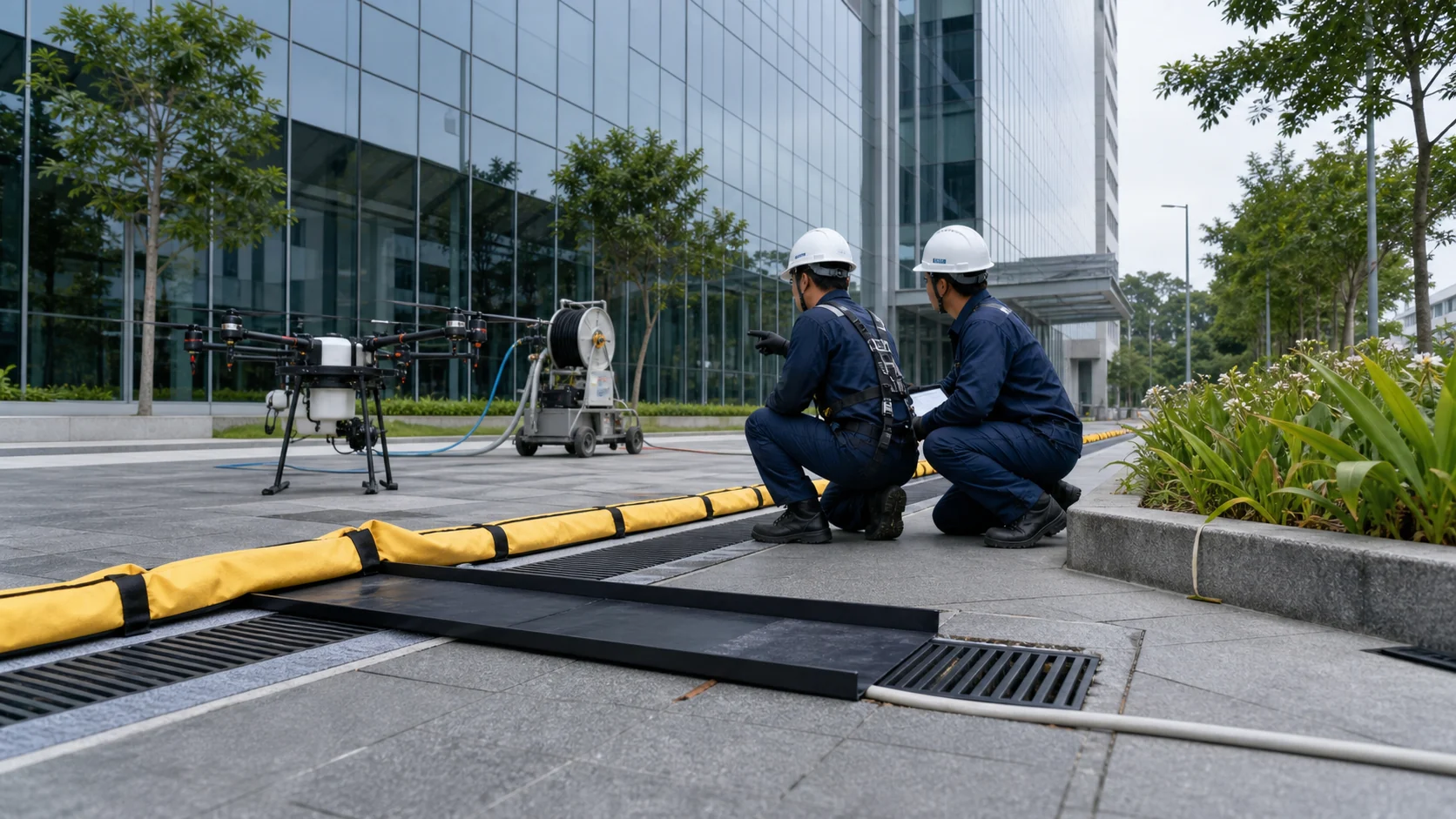
Facade cleaning uses water, and that water has to come from somewhere and go somewhere. Good facade cleaning water runoff planning answers both questions before mobilisation, so the crew is not solving supply, hose routes and drainage on the workday.
For Malaysian facility teams, these details affect safety below the work area, disruption to tenants and visitors, and the final appearance of the glass or cladding.
Quick answer: what should the plan show?
A workable plan identifies the water source and who supplies it, any water-quality or treatment assumption, the hose route, the target elevations, the expected runoff path from each one, the drains and areas that need protection, any cleaning materials proposed and the conditions under which work pauses.
1. Water source and quality
Start by confirming whether the client or the contractor supplies water and where the connection point is. Some sites limit which outlets contractors can use. If the contractor brings water, the plan should say where tanks or vehicles will stand.
Water quality matters most on glass and smooth coated surfaces. Dissolved minerals in ordinary supply water can dry into visible spots, particularly on sunlit elevations where water evaporates before it runs off. Whether treatment is needed depends on the surface, the expected finish and the manufacturer’s care guidance, so it should be stated as an assumption in the proposal. A test area can show how the chosen water dries on the actual facade.
2. Supply, pressure and hose logistics
The nearest tap may not deliver enough flow or pressure for the proposed equipment, and long hose runs or height can reduce what reaches the work area. Ask the contractor to confirm what the method needs and whether a pump, storage tank or second connection is required.
Hose routing deserves as much attention as the connection. Hoses can cross doorways, footpaths, driveways and loading bays. Plan the route, use crossing covers or barriers where people or vehicles pass and keep hoses away from sharp edges and moving machinery. Where a route cannot be protected, use a temporary closure or a different sequence instead of relying on people to step around equipment.
3. Runoff paths by elevation
Water may not fall straight down. It follows ledges, fins, window heads and canopies, and wind can carry spray sideways. Walk each target elevation and note where water may collect or drip: entrance canopies, balconies, signage, shopfronts and lower roofs.
Rain can add to the water already on site. The plan should say how the work will be paused or rescheduled if heavy rain, strong wind or standing water affects control of runoff or the ground area.
4. Drains, landscaping and ground surfaces
Inspect drains, gratings and sumps near the work area before the job. Water carrying facade dirt should not be washed into a blocked system or into a discharge point the site does not permit. The facility team is usually best placed to confirm which drains may be used and whether local authority or building management requirements apply to the site.
Landscaping below the facade may be exposed to overspray and runoff. Consider whether planters or turf need covering and whether soil could wash onto paved areas. Wet ground also affects footing: tiles, ramps and painted surfaces near entrances can become slippery, so wet areas should be marked or closed while work continues.
5. Protecting entrances, vehicles and neighbours
Entrances and drop-off points are where runoff and public movement meet. Agree which doors stay open, which are closed during each phase and how visitors, guests or staff are redirected. Parked vehicles below the facade can be exposed to spray and dirty water, so arrange for bays to be cleared or covered in advance.
Inside the boundary, protect electrical panels, external lighting, illuminated signs, air-conditioning intakes, open windows and production or loading equipment. The facility team should point out sensitive assets that may not be obvious from outside and coordinate with tenants so windows and intake systems are managed during the relevant phase.
Neighbouring property needs the same thought. Spray can drift across a boundary wall onto cars, shopfronts or a neighbour’s facade. Where a target elevation faces an adjacent site, the plan should state how drift will be limited and who informs the neighbour before work starts.
6. Choosing cleaning chemistry
Water alone may be enough for dust and light traffic film. A cleaning agent should be proposed only when there is a reason for it, not simply because water is slow. Before approval, confirm that the product is compatible with the glass, coating, frames, seals and adjacent materials, and review its safety data, dilution, application method, rinsing and how runoff will be contained and disposed of.
Stronger chemistry will not correct mineral etching, coating damage or failed sealant, and it may make an existing defect worse. Where compatibility is uncertain, ask for a small test area first.
7. What to agree in the scope
The proposal should turn these checks into clear responsibilities. Useful points to record include:
- Who supplies water, where it connects and any treatment or storage arrangement
- The hose route and the crossing controls for people and vehicles
- Which drains may be used and how debris is kept out of them
- Areas to be covered, closed or cleared, and who arranges each one
- Any cleaning material, with its approval and handling method
- Weather and runoff conditions that pause or reschedule work
- What is recorded at completion, including photographs and any runoff issue observed
What to send for a quotation
Send the site location, target elevations, approximate height, and wide photographs that show both the facade and the ground below it. Add the location of available water points, nearby drains, entrances, parking and loading areas, and any adjacent buildings. Mention sensitive equipment, operating-hour restrictions and any coating or care guidance.
Useful sources and related Skybot guides
glass facade cleaning Johor, facade cleaning tender checklist, facade cleaning cost guide, drone cleaning site assessment guide, Skybot quote form.
FAQ
Who normally supplies water for facade cleaning?
It depends on the site and the quotation. Some clients provide a connection point and some contractors bring their own supply. The proposal should state the source, the connection location and who is responsible for any treatment, storage or pumping.
Why do water spots appear on glass after cleaning?
Minerals dissolved in the water can remain on the glass as it dries, and spots are more likely where water evaporates quickly in direct sun. Treated water, the drying method and a test area can help reduce this, depending on the glass and coating.
Can runoff go into the building’s drains?
Only into drains the facility team has confirmed may be used, after checking that they are clear. Site rules and applicable local requirements should be checked, and debris should be kept out of the drainage system.
How are entrances and parked vehicles protected during facade cleaning?
Entrances and parked vehicles are protected through a plan agreed before the work starts. This can include phased door closures or redirected access, marked wet areas, cleared or covered parking bays below the facade and controlled hose crossings.
Are cleaning chemicals needed for facade cleaning?
Not necessarily. Water may be enough for light dirt. A cleaning agent should be approved only after checking surface compatibility, safety data, dilution, rinsing and runoff handling, ideally with a small test area.
What happens if it rains during facade cleaning?
Heavy rain or strong wind can affect runoff control, footing and the finish. The scope should state the conditions under which work pauses or is rescheduled, so the decision does not depend on a discussion on the day.
Request a site-specific review
Skybot Solution can review commercial exterior-cleaning enquiries in Johor. Send the location, photographs, target areas, access notes, water points and expected result through the Skybot quote form. The team will identify what else is needed before a method or proposal is confirmed.
Water and runoff controls are part of each Skybot facade cleaning assessment in Johor.