
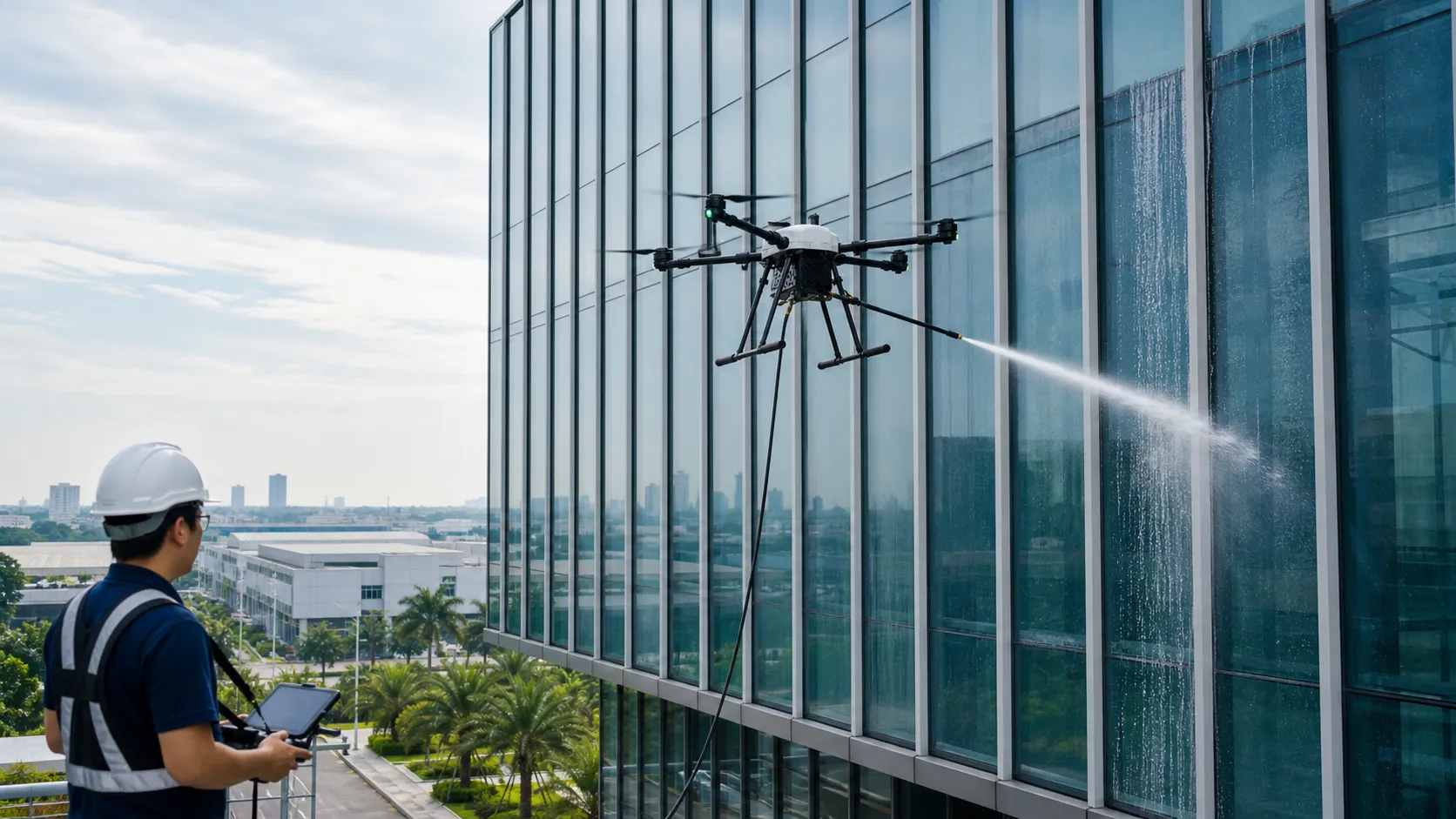
Drone facade cleaning vs rope access is not a simple question of which method is better. For building managers in Malaysia, the right choice depends on the facade shape, surface condition, access points, surrounding activity, cleaning detail required, weather, and the approval path for the work.
Drone-assisted cleaning can reduce the need to place workers directly on some elevated exterior surfaces. Rope access can still be the better method when a technician needs close contact, hand detailing, sealant inspection, minor repair, or work around complex facade features. Many commercial sites should compare both methods before asking for a final quotation.
Quick answer: when should you compare drone cleaning and rope access?
Compare both methods when the cleaning area is high, hard to reach, or disruptive to access by scaffolding or boom lift. Drone cleaning may suit broad exterior cleaning areas where the surface, flight space, water control, and safety zone are suitable. Rope access may suit detailed work, difficult corners, sensitive materials, or sections that need a trained technician close to the facade.
For Skybot Solution, the practical starting point is a site assessment. The team needs photos, location, building height, facade material, nearby roads or walkways, water access, and the target cleaning result before recommending a method. Drone cleaning is subject to site suitability, safety setup, and required approvals.
What rope access is usually good at
Rope access is a specialist access method where trained technicians use ropes, anchors, harnesses, and rescue planning to reach elevated areas. It is often used for facade cleaning, window cleaning, inspection, repair, signage work, and maintenance where direct human contact is needed.
Its main strength is precision. A rope-access technician can inspect a joint, work around balcony edges, scrub a stubborn section by hand, check a facade detail closely, or clean areas where a drone spray pattern would not be controlled enough.
Its constraints are also practical. Rope access requires trained personnel, anchor or suspension planning, rescue arrangements, falling-object controls, and careful management of activity below the work area. Depending on the site, it may also require more time on facade, more manpower coordination, and more disruption near entrances, walkways, parking bays, or tenant areas.
What drone facade cleaning is usually good at
Drone-assisted facade cleaning is useful when the target area is broad, elevated, and suitable for controlled water-based cleaning from a drone platform. The main benefit is access: the cleaning tool reaches the surface while the operator and support team remain on the ground or another planned safe operating position.
That can make sense for glass, cladding, upper facade areas, selected rooftop edges, warehouse walls, and exterior sections where traditional access setup would be slow or disruptive. It can also help property teams document the job with before-and-after photos, flight planning notes, and a clearer record of what was assessed.
But drone cleaning is not a shortcut around planning. Wind, rain, overspray, drainage, nearby people, traffic, flight space, surface sensitivity, water supply, electrical equipment, and local site restrictions all affect whether the method is suitable. If the surface needs hand scraping, close inspection, repair, or chemical treatment that cannot be controlled safely, another method may be better.
Comparison table for facility teams
| Factor | Drone-assisted facade cleaning | Rope access |
|---|---|---|
| Best fit | Broad elevated cleaning areas where flight space, water control, and ground safety zones are workable | Detailed hand cleaning, close inspection, minor repair, and complex facade features |
| Worker-at-height exposure | May reduce the need for workers to be positioned directly on some high facade areas | Requires trained technicians to work at height with rope systems and rescue planning |
| Surface contact | Usually less direct physical contact with the surface | Direct human contact is possible for scrubbing, inspection, and detail work |
| Setup considerations | Needs flight area, ground exclusion zone, water supply, weather check, and approval review | Needs anchor planning, rope systems, trained personnel, rescue plan, and area control below |
| Disruption | May reduce access setup disruption where the site layout supports drone operations | Can be targeted and precise, but activity below the working line must be controlled |
| When to avoid | Unsuitable flight space, sensitive surfaces, strong wind, uncontrolled overspray risk, or required approvals not in place | Poor anchor options, high public exposure below, unsafe weather, or scope better handled by a different access method |
Safety questions to ask before choosing either method
A serious contractor should be able to explain how the work area will be controlled. Before approving a facade cleaning proposal, ask:
- What parts of the building will be cleaned, and what parts are excluded?
- What access method is recommended for each section?
- Where will people, vehicles, tenants, and public walkways be protected?
- How will falling objects, water runoff, overspray, and electrical risks be managed?
- What weather limits apply?
- What photos or records will be provided after the job?
- What approval, permit, or site permission checks are needed before work begins?
For drone operations, the approval route must be checked for the specific work. CAAM’s public UAS guidance describes Standard Authorisation to Fly as a low-risk route and states that Standard ATF covers operations with no spraying or dispensation operations. That is why cleaning work should be reviewed carefully instead of assuming one approval path applies to every project. See the Civil Aviation Authority of Malaysia UAS guidance for the current public overview.
When drone cleaning may be the better starting point
A drone-assisted assessment may be worth considering when the building has large exterior surfaces, hard-to-access upper sections, limited space for scaffolding, or a maintenance team that wants to reduce direct work-at-height exposure where practical.
It may also be useful when the building manager needs a quicker site review before deciding whether to request a detailed cleaning proposal. Photos and a site walk-through can help identify whether the facade is suitable for drone cleaning, rope access, boom lift, water-fed pole, or a combined method.
For local commercial buildings, the wider facade cleaning services Johor guide explains what property teams should prepare before requesting a quote.
When rope access may still be the better method
Rope access may be the better choice when the work needs direct hand pressure, close inspection, spot treatment, sealant review, repair support, or careful cleaning around corners, fins, signage, ledges, balconies, and tight facade geometry.
It may also be more appropriate where drone flight space is restricted, the surrounding area cannot be safely controlled, overspray would affect nearby property, or the cleaning area is too detailed for a drone pass to deliver the expected finish.
The important point is not to force the method. If a contractor only sells one access method, the building manager should still ask whether another method would be safer, cleaner, or more practical for part of the job.
What Skybot needs before recommending a method
To review whether drone cleaning may suit a facade, Skybot usually needs:
- building name or site location;
- photos of the facade, ground area, access roads, entrances, and nearby obstructions;
- estimated building height or number of floors;
- facade material such as glass, cladding, concrete, tiles, or painted surface;
- the type of staining or dirt visible;
- water source and drainage notes;
- preferred working hours and site restrictions; and
- any management, tenant, or local authority requirements already known.
From there, Skybot can advise whether a drone-assisted method is worth assessing further, whether another access method should be considered, and what details are needed for a useful quotation.
FAQ
Is drone cleaning safer than rope access?
Drone cleaning may reduce the need to place workers directly on some elevated exterior surfaces, but it still requires safety planning, trained operators, ground controls, weather checks, and the correct approval route. Rope access also has formal safety controls and can be appropriate for detailed work. The safer method depends on the site and scope.
Can drone cleaning fully replace rope access?
No. Drone cleaning does not fully replace rope access for every building. Rope access may still be needed for hand detailing, inspection, repairs, difficult corners, and surfaces that need close contact.
Is drone facade cleaning always cheaper?
No. Cost depends on access, height, surface condition, water setup, safety controls, approvals, travel, and the finish required. Drone cleaning may reduce some access setup on suitable sites, but it should not be treated as automatically cheaper for every project.
What approval is needed for drone cleaning in Malaysia?
The approval path depends on the operation. CAAM’s public guidance states that Standard ATF is for low-risk operations and excludes spraying or dispensation operations, so cleaning work needs careful review before any flight or cleaning activity is planned.
What should I send before asking for a quote?
Send the location, facade photos, estimated height, surface type, visible stains, nearby access conditions, water source notes, and any site restrictions. This helps Skybot advise whether drone-assisted cleaning is suitable before preparing a proposal.
Next step for building managers
If you manage a commercial building, factory, warehouse, hotel, showroom, or solar site in Johor, Skybot Solution can review your site photos and advise whether drone-based cleaning is suitable. Start with the Skybot process overview, review the main service areas, or send the site details through the quote form.