
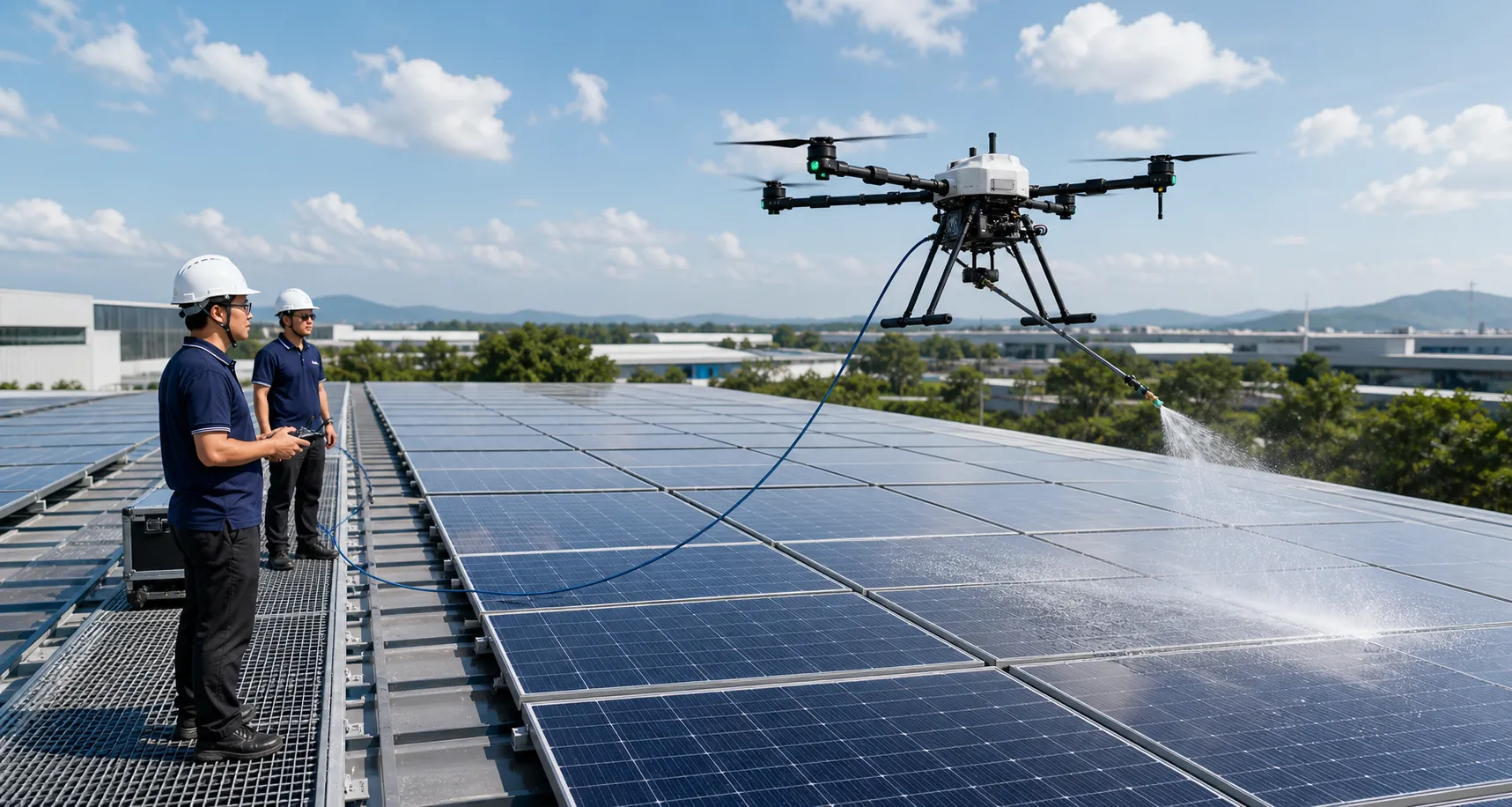
Commercial solar panel cleaning in Malaysia should begin with the roof, the soiling pattern and the site’s operating constraints, not a fixed price per panel. A useful proposal needs to account for safe roof access, array layout, water supply, drainage, electrical equipment, working hours and the evidence used to confirm that cleaning is needed.
For facility managers, the practical objective is not simply to make modules look clean. It is to plan work that protects the roof and PV system, controls access around live equipment and gives the maintenance team a clear record of what was cleaned.
Facility teams ready to request a project review can use Skybot’s commercial solar panel cleaning service page to prepare the site photographs, array details, access information and water inputs needed for an initial assessment.
Quick answer: what should a commercial site prepare?
Prepare the site address, roof and array photographs, approximate system size, module layout, access route, known roof restrictions, water availability, drainage points and recent maintenance records. If monitoring data shows an unusual production change, include that information, but do not assume dirt is the only possible cause.
These inputs help a contractor decide whether the site needs a closer survey, what cleaning method may be suitable and which risks must be controlled before a quotation can be finalised.
Why commercial rooftop cleaning needs site-specific planning
A factory or warehouse roof is an operating environment. Cleaning teams may be working near skylights, fragile roof sheets, cable routes, inverters, drains, vents, roof edges and active production areas below. The array may also be split across several roof levels with different access conditions.
That means two systems with the same number of panels can require very different work plans. One may have a permanent staircase, clear walkways and nearby water. Another may need controlled ladder access, longer hose routing, additional edge protection and work outside production hours.
Seven checks that shape the cleaning plan
1. Soiling type and distribution
Dust, bird droppings, leaf residue, industrial fallout and organic growth do not behave in the same way. The team should record whether the contamination is light and even, concentrated near roof edges, or hardened in particular sections. This affects the method, time and expected result.
2. Roof access and movement
The route from ground level to the array matters. A proposal should identify the access point, safe movement areas, fragile surfaces, skylights, roof openings and any sections that must remain off limits. Photographs are useful, but a site visit may still be needed before work.
3. Array layout and obstacles
Panel spacing, row length, tilt, cable trays, lightning protection, vents and parapets affect how the team can reach and clean the modules. Dense layouts can increase manual movement and hose-management requirements even when the total array area is modest.
4. Water quality, supply and runoff
The contractor needs to know where water can be drawn, how far it must travel and where runoff will go. Water and cleaning materials should be compatible with the module manufacturer’s instructions. Drainage must not create a slip hazard, enter sensitive production areas or carry debris into blocked outlets.
5. Electrical and equipment boundaries
PV modules generate electricity when exposed to light. Cleaning planning should respect the site’s electrical procedures and keep unapproved activity away from connectors, damaged cables, isolators and inverters. Any suspected defect should be referred to the site’s qualified PV or electrical service provider.
6. Weather and working window
Rain, wind, roof temperature and changing weather affect both safety and cleaning quality. The site should agree on stop-work conditions and a realistic work window. Production schedules, deliveries, tenant activity and noise restrictions may also limit when roof access is allowed.
7. Documentation and acceptance
Agree on how the completed work will be recorded. Useful evidence can include dated photographs, areas completed, exclusions, visible defects observed and notes on sections that could not be accessed. Cleaning documentation is not a substitute for electrical testing or a formal PV inspection.
What affects a commercial solar cleaning quotation?
| Input | Why it matters |
|---|---|
| Array size and layout | Determines the working area, movement pattern and number of separate roof zones. |
| Access route | Changes setup time, equipment movement and required access controls. |
| Soiling condition | Light dust and hardened deposits can require different treatment and time. |
| Water and drainage | Affects hose routing, supply arrangements and runoff management. |
| Roof hazards | Skylights, fragile sheets, edges and restricted zones require additional controls. |
| Working hours | Night, weekend or shutdown work can change mobilisation and supervision needs. |
| Reporting scope | Before-and-after records, zone logs and defect observations add deliverables. |
A responsible quotation should also state assumptions and exclusions. For example, cleaning may exclude electrical repairs, module replacement, roof repair, vegetation removal or treatment that has not been approved for the panel surface.
Where drone-assisted cleaning may fit
Drone-assisted cleaning may be assessed for selected commercial arrays where the roof, flight space, water control, module layout and surrounding area are suitable. It may reduce the need for personnel to move across some parts of a difficult roof, but it does not remove the need for ground controls, competent operation, weather limits and an operation-specific approval review.
CAAM’s current public UAS guidance states that Standard Authorisation to Fly is for low-risk operations and excludes spraying or dispensation. A cleaning operation therefore needs its approval path checked for the specific activity rather than being assumed to fall under Standard ATF. See the CAAM UAS guidance.
For a broader view of drone applications, read Skybot’s drone cleaning services overview. The existing solar panel cleaning cost guide explains why a site-specific quotation is more useful than a flat rate.
Common planning mistakes
- Requesting a price using only the panel count.
- Assuming all visible output loss is caused by dirt.
- Ignoring the route between the roof access point and the array.
- Using cleaning materials without checking manufacturer guidance.
- Planning work without confirming drainage and activity below the roof.
- Treating cleaning photographs as proof of electrical performance.
The National Renewable Energy Laboratory’s PV operations and maintenance guidance treats cleaning as part of a wider O&M strategy rather than an isolated cosmetic task. Facility teams can review the NREL PV O&M guide alongside the system supplier’s requirements.
FAQ
How much does commercial solar panel cleaning cost in Malaysia?
The cost depends on array area, access, roof hazards, soiling, water setup, working hours and reporting requirements. Panel count alone is not enough for a reliable quotation.
Can cleaning be done while the solar system is operating?
The site’s PV provider and electrical procedures should determine the operating arrangement. Modules remain electrically active in daylight, so the cleaning plan must respect electrical boundaries and any shutdown or isolation requirements.
Does every commercial solar roof need drone cleaning?
No. Manual tools, specialist access methods or a combined approach may be more suitable. Drone-assisted cleaning should only be considered after reviewing the roof, array, flight area, water control and approval path.
What should be included in a cleaning report?
A practical report can identify the date, completed zones, exclusions, before-and-after photographs and visible issues observed. It should clearly distinguish cleaning observations from electrical inspection or performance testing.
What should I send for a site review?
Send the location, roof and array photographs, approximate system size, access details, soiling concerns, water availability, preferred working hours and any recent maintenance or monitoring information.
Request a commercial rooftop review
Skybot Solution can review commercial solar rooftops in Johor and advise whether drone-assisted cleaning is suitable for further planning. Send the site details through the quote form, or review Skybot’s site-assessment process before requesting a proposal.