
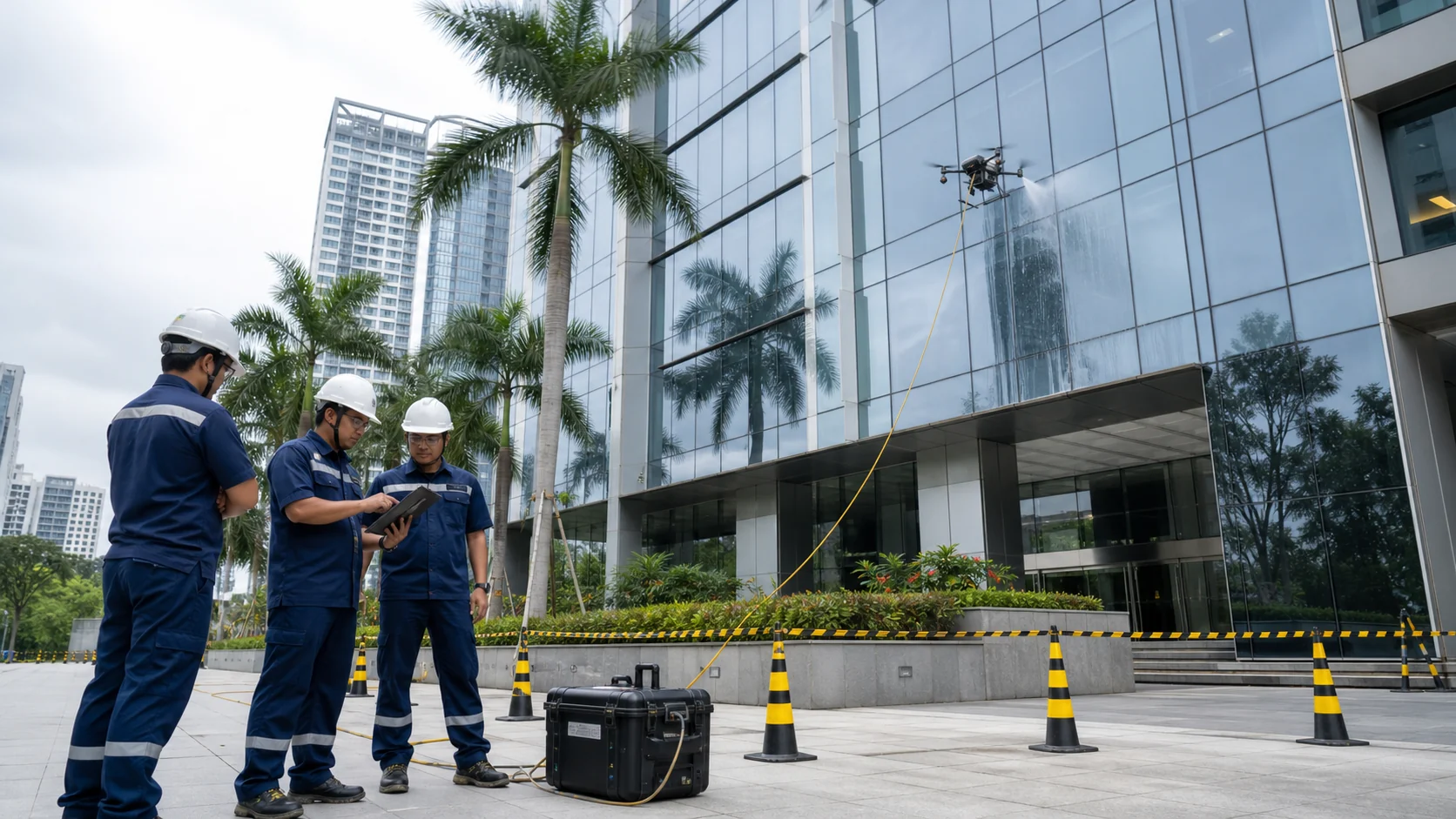
high rise cleaning safety Malaysia is a practical planning question for Malaysian facility teams.
High-rise exterior cleaning should start with the work method and the hazards it creates, not with a promise that one access system is always safer. Facility managers need to understand who will be exposed, how the area below will be controlled, what can stop the work and how the team will respond if conditions change.
A useful contractor discussion covers the facade or roof scope, access method, worker competence, equipment, weather limits, falling-object and water controls, communications, emergency arrangements and the approvals that apply to the selected method.
Quick answer: what should a facility manager check first?
Ask for a site-specific method statement and risk assessment that match the actual building. Confirm the target areas, exclusions, operating positions, access routes, public interfaces and emergency contacts before approving mobilisation.
Malaysia’s Department of Occupational Safety and Health advises a control sequence for work at height: avoid the work at height where practical, prevent falls where it cannot be avoided, and reduce the distance or consequences of a fall when risk remains. The selected cleaning method should be tested against that sequence, not chosen from habit.
1. Is the cleaning scope precise?
The proposal should identify every elevation, roof zone, ledge, canopy and excluded section. A vague instruction to clean the whole exterior can hide major differences in access, surface condition and exposure below.
Define whether the expected result is routine dirt removal, stain treatment, glass detailing or another outcome. Repairs, sealant work and electrical inspection should not be assumed to be part of a cleaning scope.
2. How will access and equipment be controlled?
Rope access, mobile platforms, scaffolding, ground tools and drone-assisted cleaning create different hazards. Ask why the recommended method fits each zone and what competency, inspection and rescue requirements apply.
Safe routes to the work area matter as much as the cleaning position. Roof hatches, fragile surfaces, anchor points, loading areas, stairs and equipment transfer routes should be included in the assessment.
3. What happens below the work area?
Entrances, walkways, parking, roads, loading bays and neighbouring property may be affected by water, debris, hoses or equipment. The contractor should explain exclusion zones, barriers, spotters and how unauthorised entry will be prevented.
Phased work or off-peak hours may reduce disruption, but the arrangement must be agreed with security, tenants and facility operations before work starts.
4. What are the weather and stop-work rules?
Wind, rain, visibility, lightning risk and wet surfaces can change quickly. The proposal should define who monitors conditions, who has stop-work authority and how an interrupted area will be left safe.
A forecast supports planning but does not replace checks at the actual facade or roof. Upper building edges can experience conditions that differ from ground level.
5. Is emergency planning credible?
Ask how the team will communicate, recover equipment, respond to injury, manage a water-line failure and contact site emergency personnel. The plan should reflect the method and building, not be a generic paragraph reused for every job.
Client representatives should know what access, utilities and emergency support they are expected to provide. Responsibilities need to be clear before mobilisation.
Planning checklist
- Exact work zones and exclusions
- Method selected for each zone
- Competent personnel and inspected equipment
- Ground exclusion and traffic controls
- Weather limits and stop-work authority
- Water, runoff and electrical boundaries
- Emergency, rescue and communication plan
- Client permits, induction and coordination requirements
Useful sources and related Skybot guides
DOSH work-at-height guidance, DOSH Occupational Safety and Health Act, drone cleaning versus rope access comparison, drone cleaning site assessment guide, Skybot quote form.
Common mistakes
- Choosing a method only from headline price
- Accepting a generic risk assessment with the wrong site details
- Ignoring the public and vehicle area below the work
- Treating good weather at ground level as proof upper areas are suitable
- Assuming cleaning includes repair, restoration or formal inspection
FAQ
Is drone cleaning automatically safer than rope access?
No. It may reduce direct worker exposure on some elevated surfaces, but it creates flight, hose, water and ground-control risks. The safer option depends on the site, scope and controls.
Does every high-rise cleaning job need rope access?
No. Ground tools, platforms, scaffolding, drones or mixed methods may fit different zones. The assessment should justify the choice.
Who should review the risk assessment?
The contractor and the client representative responsible for the site should review it, with competent safety or technical personnel involved where required.
What should stop exterior cleaning work?
Unsafe wind or rain, lightning risk, uncontrolled public entry, equipment problems, loss of communications or any condition outside the agreed limits should trigger reassessment or stop-work.
What information should I send for a safety review?
Send the location, building photos, height, target elevations, access routes, activity below, water points, operating hours and site rules.
Request a site-specific review
Skybot Solution can review commercial exterior-cleaning enquiries in Johor. Send the location, photographs, target areas, access notes and expected result through the Skybot quote form. The team will identify what else is needed before a method or proposal is confirmed.