
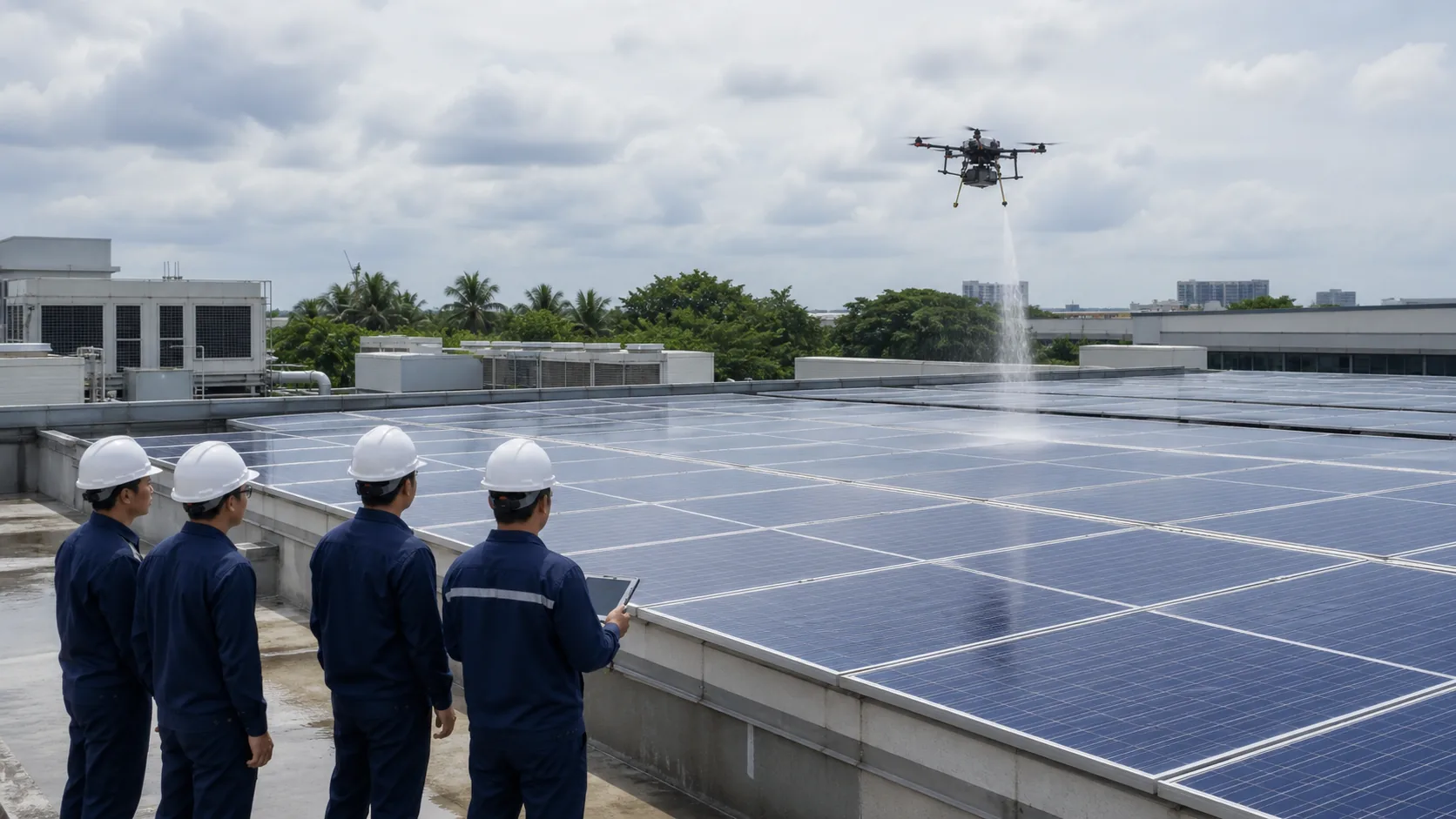
How often should solar panels be cleaned in Malaysia? For a commercial rooftop, there is no single interval that fits every site. The cleaning frequency should respond to measured soiling, rainfall exposure, nearby dust sources, bird activity, roof access, manufacturer guidance and the value of any recoverable production loss.
A fixed monthly schedule may waste budget on a clean site. Waiting until panels are visibly dirty may also be too late for a site with uneven deposits or difficult access. The better approach is to set an inspection trigger, compare clean and soiled conditions and adjust the programme using evidence.
Quick answer: start with an inspection cycle
Commercial sites can begin with regular visual checks and monitoring review, then schedule cleaning when contamination, output trends or site conditions justify it. Record the date, affected zones, weather pattern and result after cleaning. After several cycles, the facility team can set a more reliable site-specific frequency.
Do not treat a production change as proof that cleaning is needed. Shading, equipment faults, outages, temperature, curtailment and monitoring problems can also affect output. Refer suspected electrical issues to the site’s qualified PV service provider.
Factors that shorten the cleaning interval
Industrial dust and nearby activity
Factories, construction, quarry activity, unsealed roads and frequent heavy-vehicle movement can increase airborne deposits. Roof sections near exhausts or process emissions may soil differently from the rest of the array.
Bird droppings and organic debris
Localised bird deposits, leaves and plant material can create concentrated contamination even when most panels look acceptable. These sections may need targeted attention before a full-site cleaning is justified.
Low tilt and poor natural runoff
Array tilt, frame edges and drainage paths affect where dirt collects. Rain can move loose dust but may also leave deposits at lower module edges. A site should inspect the actual pattern rather than assume rainfall delivers uniform cleaning.
Long dry periods
During dry weather, loose and bonded contamination can accumulate between rain events. The effect will vary with site exposure and the type of deposit, so the cleaning decision should still be evidence based.
High-value or performance-sensitive operation
A large commercial system may justify closer monitoring because a small percentage change can have more financial significance than on a small installation. The decision should compare the likely recoverable benefit with access, cleaning and operational costs.
Factors that may support a longer interval
A site with limited dust sources, good module tilt, even rainfall exposure and stable monitoring may not need frequent cleaning. Safe access costs can also influence the practical schedule. Extending the interval should be a recorded maintenance decision, not an assumption that rain always keeps the array clean.
A practical decision framework
| Evidence | Decision use |
|---|---|
| Visual inspection | Identifies uneven dust, droppings, leaf debris and blocked drainage. |
| Monitoring trend | Flags changes that need investigation, while allowing for weather and system factors. |
| Clean reference or test section | Helps compare a cleaned area with representative soiled modules where technically appropriate. |
| Site events | Captures construction, haze, dry periods or nearby industrial activity. |
| Manufacturer guidance | Sets approved methods, materials and warranty-related limits. |
| Access and safety review | Confirms whether the planned work can be completed with suitable controls. |
| Previous cleaning result | Shows whether the prior interval and method delivered useful improvement. |
Suggested maintenance process
- Set a recurring inspection and monitoring review.
- Record contamination by roof zone instead of treating the array as uniform.
- Investigate production changes before assigning the cause to soiling.
- Check module, mounting and warranty instructions before selecting a method.
- Plan access, electrical boundaries, water and drainage controls.
- Document completed areas and visible defects.
- Compare the post-cleaning condition and update the next inspection date.
The National Renewable Energy Laboratory’s PV operations and maintenance guidance places cleaning within a broader maintenance programme and recognises that practices vary by system and condition. Facility teams can use the NREL PV O&M guide as a reference alongside local site information and manufacturer requirements.
Can rainfall replace planned cleaning?
Rainfall can remove some loose material, but it does not guarantee that bird droppings, bonded deposits, leaf residue or dirt collected at module edges will be removed. Rain exposure may also be uneven across roof sections. Inspect after representative weather events instead of using rainfall alone as the maintenance rule.
When drone-assisted cleaning may be considered
Drone-assisted cleaning may be assessed where array layout, roof condition, surrounding flight space, water control and site access support it. It does not replace the need for competent planning or the correct operation-specific approval route.
CAAM’s public UAS guidance states that Standard ATF excludes spraying or dispensation, so a cleaning operation needs specific review. See the current CAAM UAS guidance. For quotation inputs, read Skybot’s commercial rooftop solar cleaning guide.
Skybot’s existing solar panel cleaning cost guide explains how access, condition and reporting affect a site-specific proposal.
Common frequency mistakes
- Using the same interval for every roof zone.
- Assuming all rain events clean the array equally.
- Cleaning after every output change without checking for faults.
- Ignoring manufacturer restrictions on tools, water or cleaning materials.
- Failing to record whether cleaning produced a useful result.
- Scheduling work without reviewing safe access and electrical boundaries.
FAQ
Should solar panels be cleaned every month in Malaysia?
Not automatically. Monthly cleaning may suit some exposed or heavily soiled sites, while another site may justify a longer interval. Use inspection, monitoring, site conditions and prior results to set the schedule.
Does heavy rain clean solar panels?
It may remove loose dust, but it may not remove bird droppings, bonded dirt or deposits at module edges. Check the array rather than assuming rainfall completed the maintenance task.
How do I know if dirty panels are reducing output?
Use monitoring review and, where appropriate, a technically controlled comparison. Account for weather, shading, equipment status and other causes. A qualified PV provider should investigate suspected electrical faults.
Can frequent cleaning damage solar panels?
Incorrect tools, materials, water quality or technique can create risk. Follow the module manufacturer’s cleaning and warranty guidance and use a method suited to the system.
What records should a facility team keep?
Keep inspection dates, photographs, soiling observations, relevant monitoring notes, completed cleaning zones, exclusions and the next review date.
Set a site-specific cleaning programme
Skybot Solution can review commercial rooftop photographs, access conditions and soiling concerns in Johor. Send the site information through the quote form for an initial suitability review.